Democracy, Ethics and Health (DEH) Research Programme
Advancing democratic health governance
Health systems are undergoing profound transformation. Demographic change, rising costs, technological innovation and artificial intelligence are reshaping how healthcare is delivered and how collective choices about health are made. At the same time, citizens increasingly expect a voice in decisions that affect their lives, while trust in institutions and expertise is being challenged.
The Democracy, Ethics and Health Research Programme investigates how democratic societies can make legitimate, evidence-informed and revisable collective decisions about health.
We ask not simply how participation can be increased, but when and under which conditions it contributes to responsible health governance. Whose knowledge and preferences count? How should expertise, public values and minority rights interact? Who benefits from a policy, who bears its burdens, and how should institutions learn from its consequences?
From information to collective learning
Democratic health governance requires more than opportunities for participation. It depends on institutions that generate relevant knowledge, enable fair public reasoning, make assumptions and trade-offs visible, learn from evidence and experience, and remain able to revise their decisions.
Our research connects five functions in an iterative cycle:
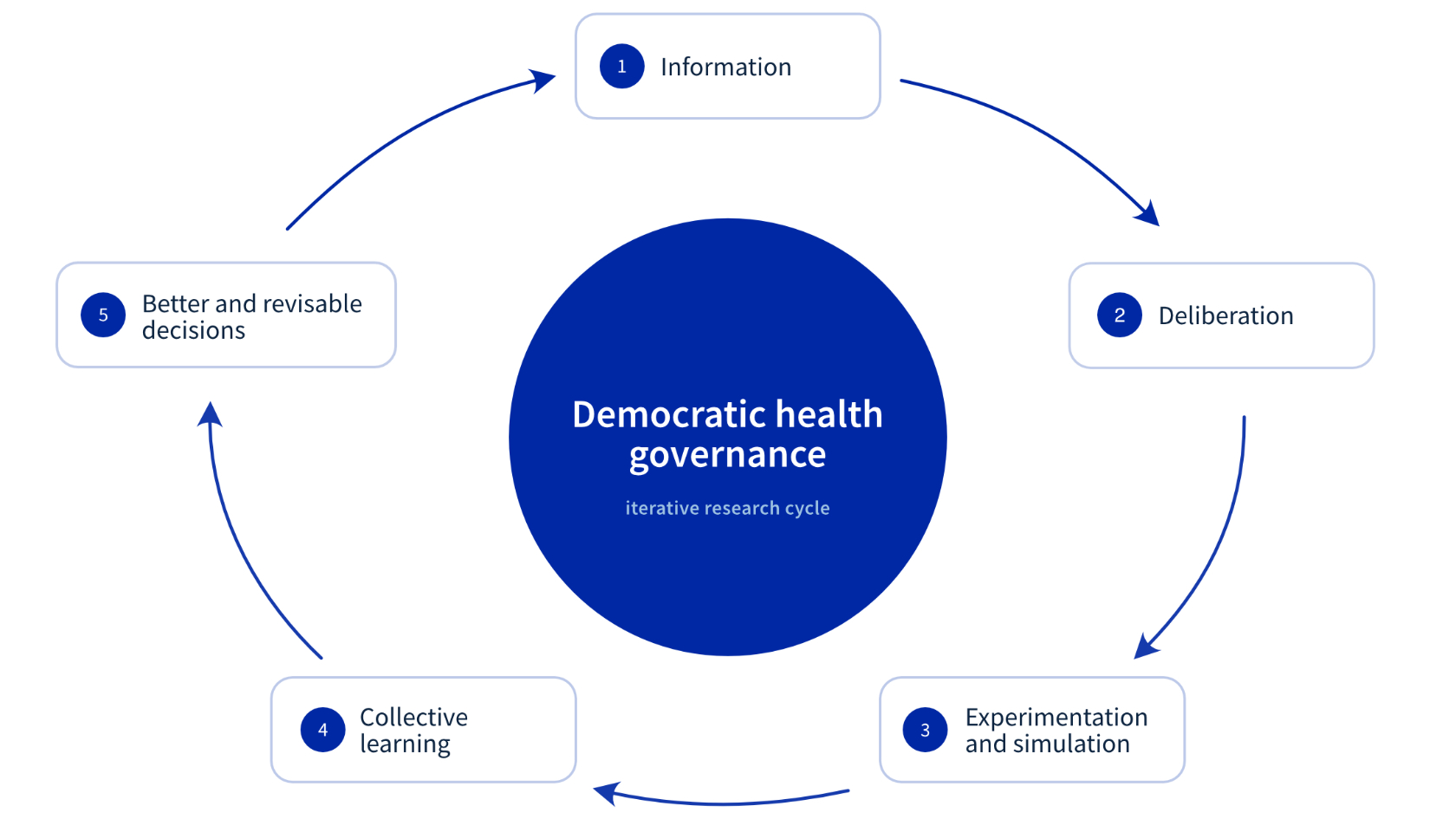
The cycle does not end with a decision. Its consequences generate new information, new experiences and new questions.
Health System Futures Observatory
The programme is developing a Health System Futures Observatory as an integrated research infrastructure for democratic health governance.
The Observatory will connect evidence about health systems with population preferences, lived experiences, ethical analysis, modelling and participatory policy experiments. Conventional observatories primarily monitor, compare and interpret developments. The Futures Observatory will complement these functions with an experimental layer: the ability to explore how selected interventions and shocks might propagate across a health system and affect different population groups.
The Observatory is not a single database, model or public-engagement exercise. It provides the shared environment in which several research initiatives can inform one another.
Research initiatives
Preference Epidemiology and the Health Preferences Atlas
Established research area; Atlas in development
Preference Epidemiology systematically investigates how individuals and populations evaluate medical interventions and policy options. It maps variation in priorities, thresholds of acceptability and attitudes towards benefits, risks and burdens.
The planned Health Preferences Atlas will make this variation visible across populations, places and time. Like an atlas of healthcare use, it will reveal patterns that national averages can obscure—but it will map what people value rather than which services they receive. Preference evidence can complement clinical and epidemiological evidence, improve communication and inform more legitimate policy processes. It does not, by itself, determine what policy should be adopted.
No Longer Patient
Active initiative
No Longer Patient is developed jointly by researchers at the University of Zurich’s Institute of Biomedical Ethics and History of Medicine and the Multi-Dimensional Medical Information (MDMI) Lab at Heidelberg University Hospital. It brings lived experience into research on democratic health governance. It collects and curates accounts from patients, caregivers and health professionals, helping to illuminate how healthcare is experienced and where institutional categories fail to capture what matters to people.
The initiative also investigates the ethical governance of AI-supported community platforms, including questions of representation, consent, editorial responsibility, transparency and community involvement. Preference Epidemiology examines what people value; No Longer Patient examines how health, illness and healthcare are experienced. These forms of evidence are complementary but not interchangeable.
The governance model underlying No Longer Patient was presented at the 18th World Congress of Bioethics in Johannesburg in 2026; the presentation slides are available online.
Democracy and Health Living Systematic Scoping Review
Active initiative
The Democracy and Health Living Systematic Scoping Review provides a continuously updated conceptual foundation for the programme. It maps how democratic governance is understood across bioethics, public health and health policy; identifies normative justifications and institutional models; and examines recurring challenges such as tokenism, unequal access, power asymmetries and tensions between expertise and public participation.
The living format allows the review to evolve as the field develops and helps identify where stronger concepts, evidence and institutional experimentation are needed. The conceptual foundations and initial findings of the review were presented at the 18th World Congress of Bioethics in Johannesburg in 2026; the presentation slides are available online.
Health System Twin
In development
The Health System Twin is the modelling and simulation component of the Futures Observatory. It is conceived as a transparent, modular and updateable infrastructure for exploring selected relationships across care delivery, workforce, financing, critical resources, information systems and governance.
Its purpose is not to reproduce every institution or predict a single inevitable future. Rather, it will support system-level investigation of how policy interventions and compound shocks may generate delayed effects, bottlenecks, spillovers and unequal distributions of benefits and burdens. A Swiss prototype will provide the initial setting in which to examine what data, modelling choices, validation strategies and governance arrangements such an infrastructure requires.
The Twin will be developed in stages and tested against historical and prospective observations. Its assumptions, uncertainty and limits of use must remain visible and contestable.
Policy Arena
In development
The Policy Arena will be a participatory interface to the Health System Twin. Citizens, patients, professionals, policymakers and researchers will be able to encounter realistic policy choices, explore projected system-wide and distributional consequences, deliberate, revise or defend their choices, and explain their reasoning.
The Arena will support research on informed preferences, public reasoning, learning and perceived legitimacy. It may include serious-game and other interactive formats, but it is not intended to turn health policy into a game. Its design must account for unequal participation, interface effects, framing, anchoring and the risk that model outputs acquire unwarranted authority.
Research foundations
The DEH Research Programme brings together more than a decade of work at IBME and with collaborating institutions in patient-centred care, empirical bioethics, institutional ethics, medicine and economics, health-system governance, priority setting, learning health systems, digital health and artificial intelligence.
Across these fields, a common question recurs: how can evidence, experience, expertise and public values be connected without obscuring disagreement or displacing political responsibility? The programme combines conceptual analysis, qualitative and quantitative research, mixed methods, participatory approaches, modelling and policy experimentation to address this question.
International and comparative outlook
The initial focus is the Swiss health system, whose decentralised governance, plural financing arrangements and rich but fragmented evidence landscape provide a demanding setting for this work. The longer-term aim is not to export a Swiss model, but to develop a reusable architecture that can be adapted through locally led partnerships.
Comparative evidence may allow common policy questions to be explored across health systems while preserving differences in institutions, values, data and decision-making authority. In the longer term, locally governed health-system twins and participatory simulation may also help communities and decision-makers examine options for health-system recovery and reconstruction under severe resource and data constraints.
Partnerships and enabling infrastructure
The programme is based at the University of Zurich's Institute of Biomedical Ethics and History of Medicine and works across disciplinary, institutional and national boundaries.
International networks
IBME is a WHO Collaborating Centre for Bioethics. Through this role, it contributes to WHO activities in biomedical and public health ethics, including education, consultation, research and networking with other collaborating centres, institutional partners and experts. This provides the DEH Research Programme with a valuable foundation for international exchange and locally grounded collaboration.
Nikola Biller-Andorno is a Senior Fellow of the Commonwealth Fund and a former Commonwealth Fund Harkness Fellow in Health Care Policy and Practice. This connection is particularly relevant to the programme's comparative health-system work and its ambition to develop the Swiss prototype through international policy learning.
Digital Health Design Living Lab
IBME co-hosts the Digital Health Design Living Lab (DHD Living Lab), a joint initiative of UZH, ZHdK and ZHAW. The DHD Living Lab is a co-creative, interdisciplinary hub that brings healthcare stakeholders together with expertise from medicine, ethics, health promotion, design and design research. It develops and studies digital-health products, processes and services and creates participatory formats for dialogue, co-design and implementation. For the DEH Research Programme, it provides an important environment for translating research into accessible participatory infrastructures, including the Health System Twin and Policy Arena.
Individual academic collaborations
The programme's individual academic collaboration partners include Barbara Prainsack, Professor of Comparative Policy Analysis at the University of Vienna, whose work encompasses health policy, solidarity and the societal dimensions of data-rich medicine; and Fruzsina Molnár-Gábor, Professor of International Medical and Health Law and Data Protection Law at Heidelberg University and Research Group Leader at the BioQuant Center, whose work addresses health data, data protection and the governance of emerging technologies.
Work with us
The DEH Research Programme welcomes collaboration with researchers, public institutions, health professionals, patient and community organisations, designers and technology partners interested in democratic health governance, preference research, participatory methods and health-system modelling.
We are particularly interested in partnerships that can contribute comparative evidence, methodological expertise, locally grounded knowledge or settings in which new approaches can be evaluated responsibly.
Programme leadership and team
Selected publications
- Spitale G, Germani F, Biller-Andorno N. Introducing Preference Epidemiology: Improving Patient-Centered Approaches in Health Decision-Making.International Journal of Public Health. 2025.
- Spitale G, Germani F, Biller-Andorno N. Perceptions and misconceptions of PSA screening in Switzerland: A preference epidemiology study. Social Science & Medicine. 2026.
- Germani F, Spitale G, Fischer C, Tag B, Reichenbach J, Devuyst O, Baumgartner M, Biller-Andorno N. Healthcare resource allocation for rare diseases: an exploratory survey of Swiss citizens’ preferences. Swiss Medical Weekly. 2025.
- Spitale G, Biller-Andorno N, Germani F, Merten S. Digital Democracy and Emergency Preparedness: Engaging the Public in Public Health. International Journal of Public Health. 2024.